You've seen a granite slab with large, swirling crystal designs that simply don't appear in any catalogue photo and you want to know what it is before you sign up for a granite countertop or granite floor? This is known as Alaska granite, a pegmatite stone that is mainly mined in Rajasthan, India, and in Brazil, and is priced at about ₹100-220 per sq ft, depending on its colour and thickness. It is not named after the US state, the most common variety is white, which is an icy colour. Here, you'll learn how it is created, the five principal types of colours, where it lasts and where it does not, and how much you should expect to spend on it.
What is Alaska Granite?
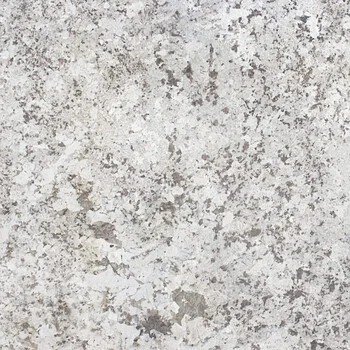
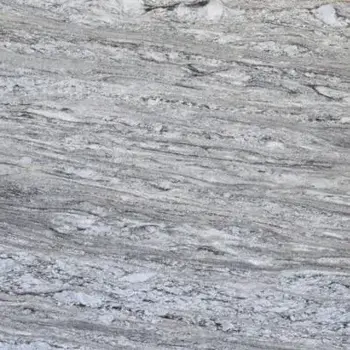
Alaska graniteis a pegmatite, a type of rock produced when the remaining magma includes more water and gas, and it cools more fluidly. This fluidity allows for the quartz to grow vs feldspar and mica crystals to grow significantly larger than in normal granite, which cools slowly and evenly throughout. Pegmatite is sold as granite for the stone trade because it has similar properties in slab form: hard, polished, cut and installed like any granite. The name "Alaska" is a trade mark that is associated with the paleness and ice-like appearance of Alaska White granite, which is the most common variety. You'll also hear the term used for resined granite slabs of granite because most granite used in Alaska is resin-treated during the processing at the factory.
Where is Alaska Granite Quarried or What is the origin of Alaska Granite?
As the name suggests, "Alaska Granite," many customers approach us and enquire whether this granite is imported from the Alaska Region of the United States. However, this is not the case; this particular form of granite is either quarried in Brazil or the Indian variation sold as Alaska granite is quarried in Rajasthan, primarily in the areas of Ajmer, Bhilwara, and Rajsamand in south-central Rajasthan.
Alaska Granite vs Regular Granite?
They are both igneous rock, and they contain the same minerals: quartz, feldspar and mica. They have different methods of cooling. Granite crystallises slowly and evenly over thousands of years over a long period of time, which means that the crystals are quite small and consistent in size, giving it a familiar "salt and pepper" appearance. Here, crystals form in the last, water and gas filled pulse, resulting in larger, less evenly-sized crystals and bigger swirls, veins and colour blocks rather than a repeating fleck pattern. In practice, it is as though two slabs of a standard black or brown granite would look virtually the same, and two slabs of Alaska granite, even from the same block, may vary enough that they need to be picked out by eye.
See Alaska Granite Slabs In Stock
Every Alaska Granite slab has a different crystal pattern — no two installations look alike. Alaska White and Alaska Gold are in regular stock at our Kishangarh factory; view current slab photos before you order.
View Alaska Granite StockHow Is Alaska Granite Processed?
Quarrying stone blocks, sending them to a granite factory, cutting them into slabs and polishing them follows the same stages as with granite. Alaska granite provides one additional step: slab resining. Resin is applied to stones with fissure-prone structures, and Alaska granite/pegmatite is one of them because of its coarse, uneven crystal growth.Natural voids, hairline cracks and pits are filled in with resin to the face of the slab. It fills in the cracks that allow dirt or moisture to get trapped, and it can even help to smooth out the stone's surface. When purchasing Alaska granite, inquire if the batch has been resined and if so, what resin has been used, as the quality of the finish is dependent on the factory especially in case of white variety, as cheaper resin can lead to yellowing in due course of time.
Also READ | Understanding the Process of Slab Resining of Natural Stones – Marble, Quartzite & Granite
Is Alaska Granite as Strong as Regular Granite?
Yes. Alaska granite and typical granite are the same hardness Mohs 6–7 because both are built from the same minerals: quartz, feldspar, and mica. The difference is crystal size and pattern, not strength.
The resin used on most Alaska granite slabs is a surface treatment, not a structural one. It fills natural voids, hairline cracks, and pits on the face of the slab. This doesn't add strength to the stone — hardness comes from the mineral structure underneath, which resining doesn't touch. It also doesn't weaken the stone; a properly resined slab performs the same as an unresined one in cutting, heat resistance, and daily wear.
What Are the Common Alaska Granite Colours?
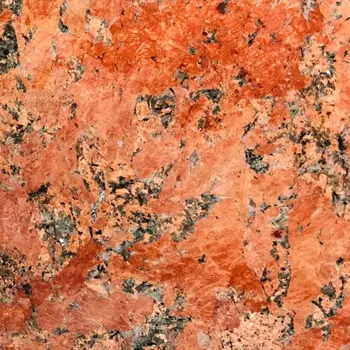
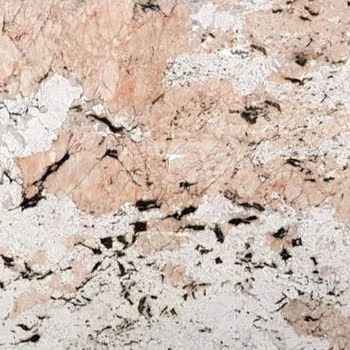
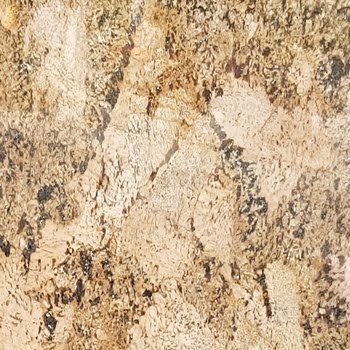
Not all Alaska granite is the same colour: it's a family of granites. The 5 most common stones at Indian stone yards:
| Alaska Granite Colours | Base colour | Use Case |
| Alaska white granite | White with grey/black veining | Countertops, flooring, wall cladding |
| Alaska Gold: | Gold-cream with fine veining; | Countertops, Table tops, Stairs & feature walls |
| Alaska Red | Red with contrasting veins | Flooring, wall cladding, kitchen coutnertops |
| Alaska Pink | Pink with some veins and patches | Bathroom vanities, accent walls, Flooring, Stairs, Table tops, etc |
| Alaska Blue | Cream base with blue/black/grey veins | Kitchen Countertop, Feature walls, flooring, feature wall, Stair steps etc. |
Stone Galleria , a natural stone manufacturer and exporter from Rajasthan has regular stock of Stone Alaska white granite and Alaska gold granite; while Alaska Red, Pink and Blue are sourced on orders.
What Are the Uses of Alaska Granite?
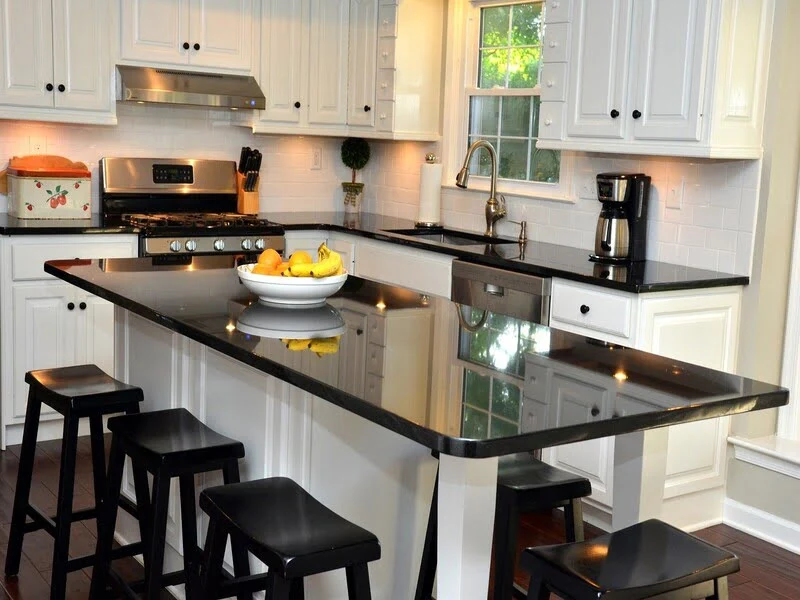
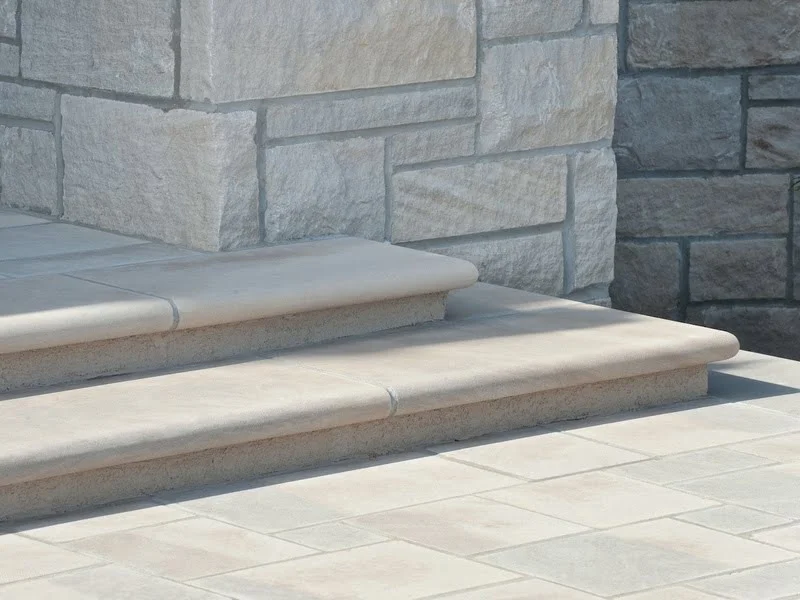
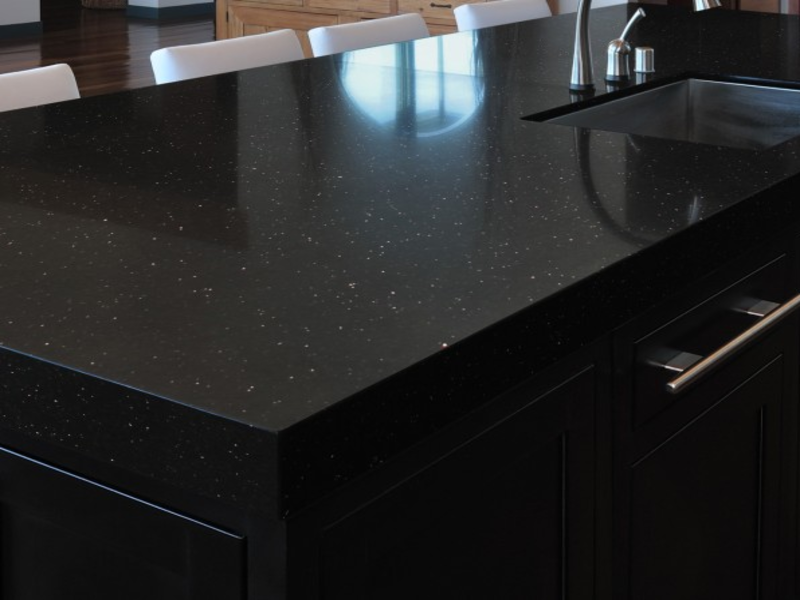
Alaska granite, with a hardness of 6-7, can be used for kitchen and bathroom countertops, in homes and commercial buildings, as flooring, for fireplace surrounds, stairs, and full-height feature walls. It is most commonly used when the pattern is the design element, not so much as a background material, like in an island countertop, a lobby wall or a hotel reception floor. If used outdoors, ask your supplier: most Alaska granites are feldspar-rich, and therefore cannot be used outside without testing for sun and weather resistance.
Alaska Granite: Same Hardness, Bolder Pattern
Mohs 6–7 hardness, same as standard granite — the crystal pattern is the only real difference. If the look works for your space, request a sample slab to check colour and veining in hand before you commit to a size.
Request an Alaska Granite SampleWhat are the pros and cons of Alaska Granite?
Pros:
- Every slab has a different pattern, so each installation is unique
- Mohs 6–7 hardness handles cutting, heat, and daily wear
- Soap and water cleaning is sufficient
- Resealing is recommended about once a year
Cons:
- Costs more than standard granite of the same thickness
- Patterns vary significantly, so matching slabs across larger surfaces needs careful selection
- Not all colours are stocked at every yard, so lead times can run longer than for common granites
- Like all granite, it's heavy, requires special handling and needs an experienced fabricator to install
Alaska Granite vs Regular Granite: Which one should you select?
Consider regular granite if you prefer the repeatability of a pattern over a large surface area, at the least expensive price per sq.ft., and if the surface is the point of interest (island, feature wall, lobby floor, etc.), you'll be okay selecting slabs for a match you're looking for. They are both equally hard and heat resistant – it depends on the pattern and budget, not on the durability.
What sizes is Alaska Granite available in?
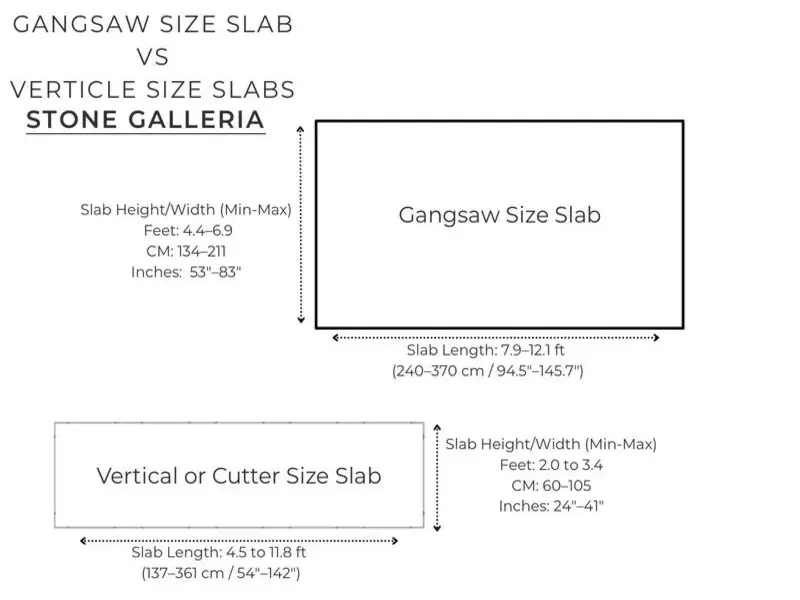
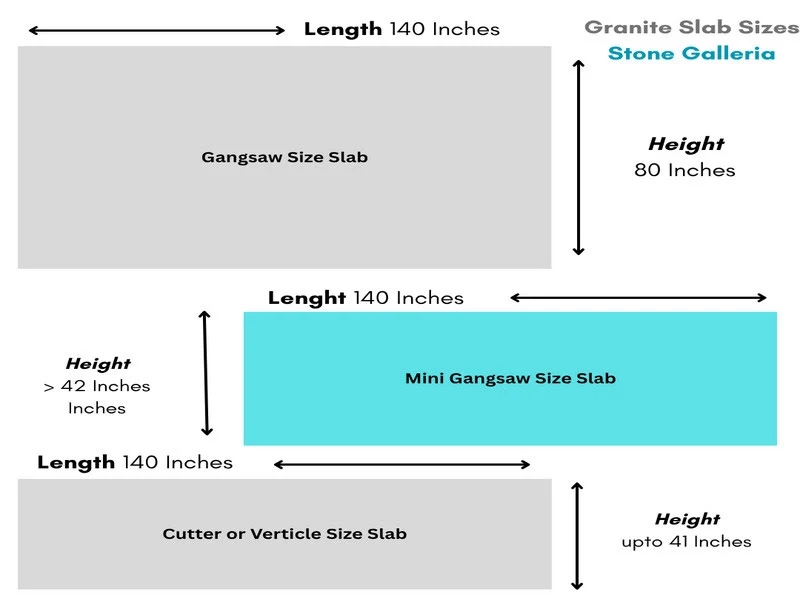
Alaska granite, like standard granite, is available in three sizes: verticle slabs, large slabs or gangsaw size slabs, tiles, and custom sizes. However, due to popularity and global demand, both gangsaw and vertical sizes are readily available in most cases, although traditional granite is rarely available in gangsaw size, resulting in a longer lead time.
Alaska granite are generally available in the following sizes:
- Tiles available in 30 x 30 cm, 30 x 60 cm, 60 x 120 cm, and custom sizes.
- Large gangsaw size slabs range in length from 250 to 330 cm and width/height from 140 to 200 cm.
- Vertical size slabs, also known as cutter size, are available in lengths ranging from 250 cm to 330 cm and widths and heights ranging from 70 to 100 cm.
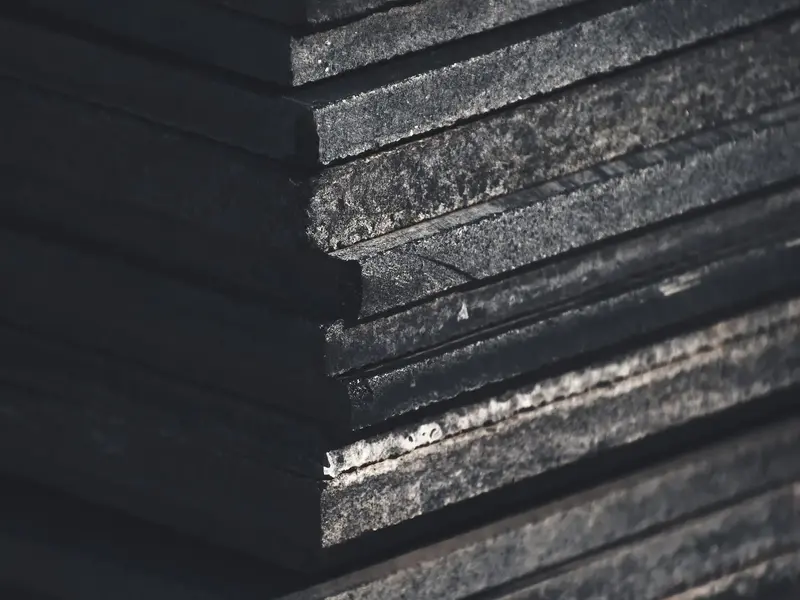
Typical slab thicknesses for gangsaw size slabs are 20 mm and 30 mm, while vertical or cutter size slabs are typically 18 mm and 20 mm thick. Thicker slabs can be produced for certain purposes upon request.
What is the price of Alaska Granite?
Color, thickness, finish and slab quality determine the prices. The data below is based on the list of suppliers available at this time across Rajasthan:
| Alaska Grantie Colours | Price range (₹/sq ft) of Cutter Size Slabs for 18+ thickness. |
| Alaska White | 100–175 |
| Alaska Gold | 120–190 |
| Alaska Red | 110–150 |
| Alaska Pink | 100–140 |
| Alaska Blue | 120–150 |
The installation cost in India is usually ₹120 to 300 per sq ft.
We have made our pricing accessible and interactive, so you can find out the price of something you like straight away without having to visit the local yard or call anyone. Simply go to the product page to see the price based on your usual size, thickness, finish, and grade. If you require a specific thickness, size, or finish, please contact us.
ALSO READ | Granite Price Per Square Foot – Understanding Factors
Where Can I Buy Alaska Granite?
Stone Galleria, a natural stone i.e., granite, sandstone, marble, quartzite and slate manufacturer and exporter in Rajasthan, processes and stocks Alaska White (multiple varieties), Blue Dunes and Alaska Gold granite regularly, with Alaska Red and Pink, processed against confirmed orders.
Samples are available on request since photos alone don't fully capture how a specific slab will feel.
Conclusion
Choose Alaska granite for use as a slab if the pattern is the design element in an island countertop, feature wall, statement floor, and are prepared to hand select slabs for a match. Both are Mohs 6-7 hardness and have the same heat resistance and therefore the choice is based on pattern and budget, rather than durability.