
 Vérifié
Dans les projets de construction et d'intérieur d'aujourd'hui, la pierre naturelle n'est plus fournie uniquement sous forme de dalles brutes. Les propriétaires, architectes et constructeurs s'attendent de plus en plus à ce que la pierre arrive finie, précise et prête à être installée.
Le granit et d'autres pierres naturelles sont désormais utilisés pour les plans de travail de cuisine, les dessus de table, les escaliers, les revêtements muraux et les éléments de design sur mesure—où même un petit décalage de taille, de forme ou de finition peut affecter le résultat final. Les coupes droites ne sont qu'une partie de l'exigence; les projets modernes impliquent souvent des courbes, des découpes d'évier, des profils de bord, de la symétrie et un ajustement précis.
Traditionnellement, une grande partie de ce travail était effectuée manuellement sur le site. Bien que la main-d'œuvre qualifiée puisse gérer les découpes de base, les méthodes manuelles deviennent chronophages, coûteuses et risquées à mesure que les conceptions deviennent plus détaillées ou lorsque la cohérence est requise sur plusieurs pièces.
Pour répondre aux attentes de qualité moderne et aux exigences de conception, le traitement de la pierre est progressivement passé du travail manuel sur site à l'usinage contrôlé en usine et guidé par ordinateur. Ce changement permet de traiter la pierre avec une plus grande précision, une meilleure répétabilité et un contrôle bien supérieur—rendant possibles des conceptions complexes et auparavant impraticables.
C'est là que la technologie CNC entre en jeu.
Les retards, reprises et gaspillages liés à la pierre surviennent le plus souvent lors de la découpe et de l'ajustement sur site. Le traitement CNC déplace ce risque hors du site et livre une pierre prête à être installée, aidant les projets à respecter le calendrier et le budget.
À qui ce guide est-il destiné :
• Architectes : Assurer que l'intention de conception survit à l'exécution
• Constructeurs & chefs de projet : Réduire les dépendances et les retards sur site
• Entrepreneurs & installateurs : Installation plus propre, plus rapide avec moins de risques
• Propriétaires & propriétaires : Moins de surprises, moins de désordre, coût prévisible

Que signifie CNC ? (Explication Simple)
CNC signifie Commande Numérique par Ordinateur. Il se réfère à des machines qui sont opérées à l'aide de programmes informatiques au lieu d'un contrôle manuel, permettant de traiter la pierre avec une grande précision et répétabilité.
Dans le traitement du granit, les machines CNC suivent des fichiers de conception numérique (dessins CAO) pour couper, façonner et finir la pierre exactement comme spécifié. L'ordinateur contrôle chaque mouvement de la machine—direction, vitesse, profondeur et action de l'outil—éliminant les approximations du processus.
La plupart des machines CNC utilisées dans le traitement de la pierre fonctionnent sur 3 à 5 axes, ce qui signifie qu'elles peuvent se déplacer dans plusieurs directions en même temps. Cela permet à la machine de gérer non seulement des coupes droites, mais aussi des courbes, des angles et des formes complexes avec une précision constante.
En utilisant des machines CNC, la pierre peut être :
- Découpée à des tailles exactes
- Profilée avec des bords droits ou courbes
- Percée pour des éviers et des accessoires
- Gravée avec des motifs et des dessins
- Fraisée sur les bords et polie sur les surfaces
En transférant le travail répétitif et critique en précision des mains humaines au contrôle programmé, le traitement CNC offre des résultats uniformes, souvent dans des tolérances inférieures au millimètre. Cela réduit les erreurs humaines, minimise le gaspillage de matériaux et produit une finition plus propre et plus professionnelle sur la pierre naturelle.
Comment le CNC est utilisé dans le traitement du granit
Dans le traitement du granit ou pour toute pierre naturelle ou même pierre reconstituée, les machines CNC sont utilisées pour convertir des dalles ou blocs bruts en produits finis précis. Une fois le design et les mesures définis, l'ensemble du processus est géré par la machine avec une implication manuelle minimale.
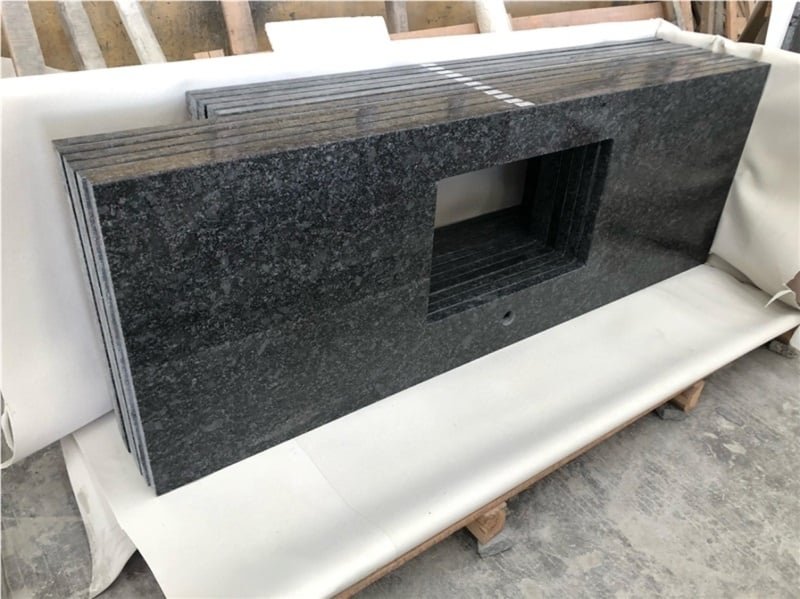
Les produits en granit préfabriqués sont généralement produits en utilisant le traitement CNC, permettant à la pierre d'être livrée entièrement finie et prête à installer.
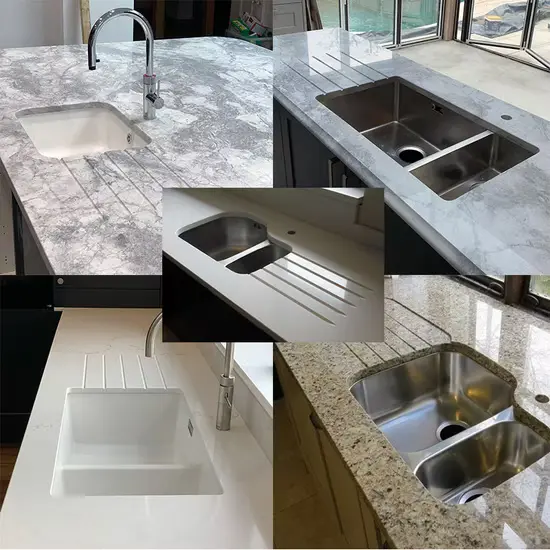
Découpes pour éviers et accessoires
Les machines CNC sont largement utilisées pour :
- Découpes pour éviers
- Trous pour plaques de cuisson et robinets
- Rainures de drainage
Ces découpes sont parfaitement alignées et répétables, ce qui est difficile à réaliser manuellement.
Gravure et travail de surface
La technologie CNC est également utilisée pour :
- Graver des motifs ou du texte
- Rainures décoratives
LIRE AUSSI | Qu'est-ce que les plans de travail en granit préfabriqués ? Avantages, inconvénients et guide d'achat
Types de machines CNC utilisées pour le granit
Différentes machines CNC sont utilisées dans le traitement du granit, selon le type de travail, le niveau de précision et l'aspect final requis. Chaque machine a un rôle spécifique dans la transformation des dalles de granit brut en produits prêts à l'emploi.
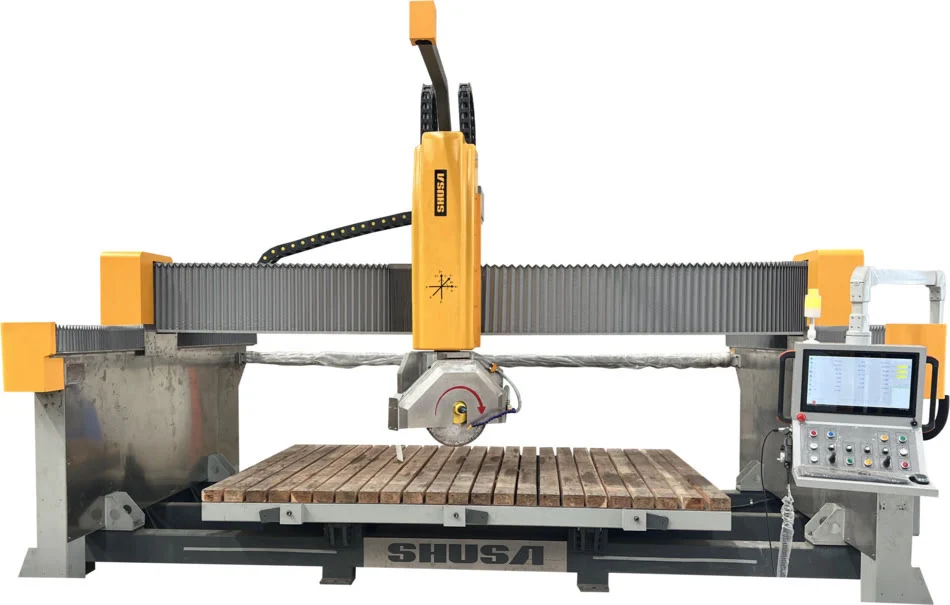
Scie à pont CNC
Machines de style portique pour des coupes droites et angulaires (0-360°), le profilage des bords et le dimensionnement des dalles ; idéales pour la production de comptoirs à grand volume avec des tables basculantes hydrauliques.
Fraiseuse et machine de gravure CNC
Spécialisée dans les sculptures 2D/3D, le lettrage, le perçage et les motifs complexes sur les surfaces en granit. Dans le traitement du granit, la gravure est généralement effectuée sur des fraiseuses CNC en changeant l'outil de coupe. Les machines de gravure CNC dédiées sont utilisées uniquement lorsque des détails très fins ou des œuvres d'art sont nécessaires.
Machine CNC 5 axes
Une version plus avancée de l'équipement CNC.
Utilisée pour :
- Formes et angles complexes
- Découpes d'éviers sous plan
- Bords sculptés et design
Les axes supplémentaires permettent à l'outil de se déplacer dans plus de directions, ce qui le rend idéal pour les travaux coûteux et sur mesure.
CNC vs Coupe manuelle du granit
La principale différence est la précision et la cohérence. La coupe manuelle du granit dépend de l'habileté humaine et peut varier d'une pièce à l'autre, tandis que la coupe CNC suit des instructions programmées pour offrir des résultats précis, répétables et uniformes avec un minimum d'erreurs.
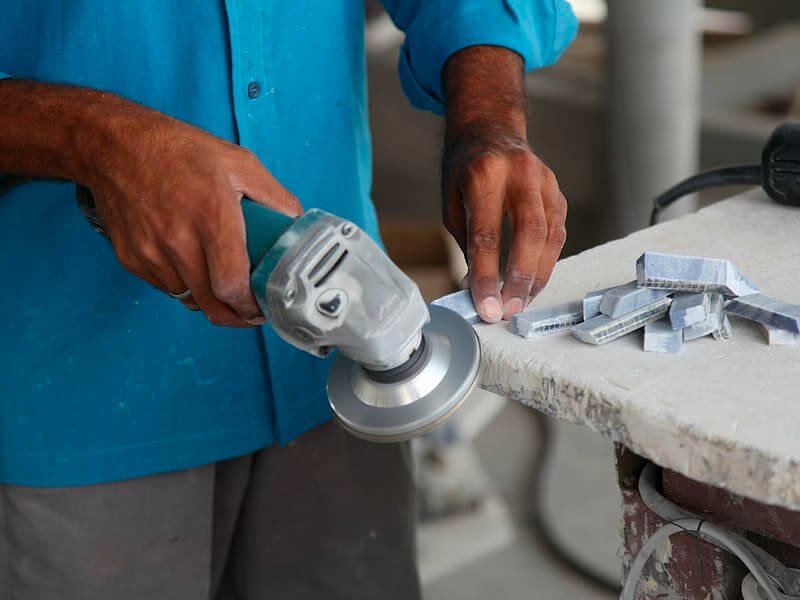
Coupe manuelle de la pierre
La coupe manuelle dépend fortement de l'habileté et de l'expérience humaine. Les travailleurs utilisent des outils comme des coupeurs, des meuleuses et des polisseuses pour façonner la pierre.
Caractéristiques
- La précision dépend du travailleur
- Les résultats peuvent varier d'une pièce à l'autre
- Plus chronophage et donc coûteux.
- La coupe sur site nécessite un espace supplémentaire pour les dalles, le travail de coupe et le granit fini.
- Plus de chances de bords inégaux ou de petites erreurs
- Convient pour des travaux simples ou de faible volume
- La coupe manuelle sur site signifie que toute erreur devient un déchet sur place.
- Avec la coupe sur site, vous payez pour la dalle entière, y compris tout gaspillage possible qui peut se produire sur place.
La coupe manuelle existe toujours, mais il est difficile de maintenir une qualité uniforme dans les projets de grande taille ou détaillés.
Coupe CNC
La coupe CNC utilise des instructions programmées par ordinateur pour contrôler la machine. Une fois le design défini, la machine répète le même processus à chaque fois.
Caractéristiques:
- Précision extrêmement élevée (souvent inférieure à 0,1 mm)
- Même résultat sur chaque dalle, carreau ou pièce
- Temps de traitement plus rapide
- Bords propres et lisses
- Idéal pour les formes complexes, les découpes d'évier et les commandes en gros
- Le granit traité par CNC est prêt à être installé, donc aucun espace de travail n'est requis sur le site.
- Le traitement en usine par CNC transfère le risque de gaspillage du site à l'usine.
- Avec le traitement en usine, vous ne payez que pour le matériau utilisable et fini, car tout gaspillage pendant le traitement est géré par l'usine.
La CNC élimine les approximations et les erreurs humaines du processus.
| Caractéristique | Découpe manuelle | Scie à pont normale | Scie à pont CNC 5 axes |
| Automatisation | Non | Partielle | Totale |
| Précision | Basse–Moyenne | Moyenne | Très élevée |
| Découpes complexes | Difficile | Limitée | Facile |
| Découpes d'évier | Manuelle | Semi-manuelle | Automatique |
| Répétabilité | Mauvaise | Moyenne | Excellente |
| Qualité de finition | Variable | Bonne | Excellente |
| Utilisation idéale | Petits travaux | Découpes droites | Projets en gros et haut de gamme |
Où les pierres traitées par CNC sont couramment utilisées
Les pierres traitées par CNC sont préférées partout où la précision, la finition propre et la cohérence sont importantes. Parce que le matériau est découpé et fini dans un environnement d'usine contrôlé, il est largement utilisé dans les projets résidentiels et commerciaux.
Applications Résidentielles
- Plans de travail de cuisine : Dimensions parfaites, bords lisses et découpes précises pour éviers font du granit CNC un choix idéal pour les cuisines modernes.
- Meubles-lavabos de salle de bain : Trous de robinet précis, bords uniformes et finitions propres améliorent à la fois l'apparence et la fonctionnalité.
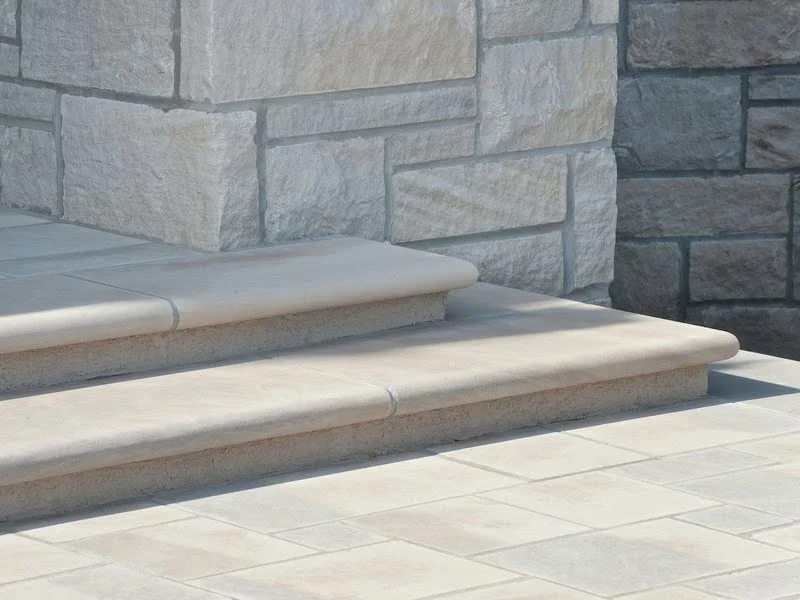
- Escaliers & marches : CNC assure une épaisseur égale, des bords droits et des dimensions cohérentes sur toutes les marches.
- Appuis de fenêtre & cadres de porte : Lignes nettes et mesures exactes aident à obtenir une finition architecturale soignée.
Applications Commerciales
- Hôtels & projets d'hospitalité : Le traitement CNC assure l'uniformité sur de grandes quantités, ce qui est essentiel pour des intérieurs haut de gamme.
- Centres commerciaux & bureaux : Utilisé pour les sols, les revêtements muraux et les comptoirs où la durabilité et la précision sont importantes.
- Hôpitaux & institutions : Un ajustement précis réduit les écarts et améliore l'hygiène et la sécurité.
Projets Sur Mesure & Design
- Plans de travail & îlots de designer : Formes complexes, courbes et joints en onglet sont facilement réalisés avec des machines CNC.
- Revêtement mural & murs d'accent : CNC permet un alignement précis des motifs et des détails décoratifs.
- Éléments en pierre gravée : Logos, textes et motifs de design sont produits avec une profondeur et une clarté constantes.
Les applications axées sur le design telles que les panneaux muraux cannelés, les surfaces nervurées et les caractéristiques en pierre texturée dépendent fortement du traitement CNC pour maintenir des rainures uniformes et des bords nets sur de grandes surfaces.
LIRE AUSSI | Pourquoi le Granit Cannelé est une Grande Tendance dans le Design de Panneaux en Pierre
Le Granit CNC est-il Plus Cher ?
À première vue, la découpe CNC peut sembler plus coûteuse que la découpe manuelle. Cependant, lorsque vous considérez le coût global du projet, la découpe CNC s'avère souvent plus rentable. Voici pourquoiCoût initial vs Coût réel
| Facteur | Découpe manuelle | Découpe en usine |
| Coût de découpe | Inférieur | Légèrement supérieur |
| Coût de gaspillage | À la charge du client | À la charge de l'usine |
| Risque de retouche | Élevé | Très faible |
| Coût de la main-d'œuvre | Plus élevé | Inférieur |
| Valeur globale | Incertaine | Prévisible |
Découpe manuelle / sur site :
Le coût de découpe peut sembler inférieur, mais vous payez pour :
- Coût de la dalle complète
- Gaspillage possible sur site
- Main-d'œuvre et temps supplémentaires
- Risque de retouche en cas d'erreurs
Découpe en usine CNC :
Le coût de découpe peut être plus élevé par unité, mais :
- Vous payez uniquement pour le matériau utilisable et fini
- Le gaspillage pendant le traitement est pris en charge par l'usine
- Le matériau arrive prêt à être installé
- Les risques de retouche sont minimes
La découpe CNC peut coûter plus cher par coupe, mais elle permet d'économiser de l'argent en réduisant le gaspillage, les retouches et les risques sur site.
Comment identifier le granit traité par CNC
Si vous n'êtes pas du secteur de la pierre, il peut être difficile de savoir si le granit a été traité par CNC ou découpé manuellement. Cependant, il existe quelques signes clairs qui rendent le granit traité par CNC facile à identifier.
Bords propres et uniformes
Le granit traité par CNC a des bords lisses et constants du début à la fin. La découpe manuelle montre souvent :
- Légère ondulation
- Épaisseur de bord irrégulière
- Petits éclats ou zones rugueuses
L'uniformité est le plus grand indice du traitement CNC.
Découpes parfaites pour évier et plaque de cuisson
- Vérifiez soigneusement les ouvertures pour évier et plaque de cuisson.
- Les découpes CNC sont précises, symétriques et lisses
- Les coins sont uniformément arrondis
- Les découpes manuelles peuvent sembler irrégulières ou rugueuses sur les bords
Mesures exactes
- Les machines CNC suivent des conceptions numériques, donc :
- La longueur et la largeur correspondent exactement aux dessins
- Plusieurs pièces s'emboîtent parfaitement
- Les joints en onglet s'alignent proprement
- Le travail manuel peut montrer de petites variations de taille.
En bref, la précision, la cohérence et la qualité du travail sont les signes du travail CNC.
- Précision : Dimensions précises, découpes parfaites et alignement exact
- Cohérence : Résultats identiques sur plusieurs pièces sans variation
- Qualité du travail : Bords lisses, profils nets et finition professionnelle
Si une pièce s'adapte parfaitement, semble uniforme partout et ne nécessite aucune correction sur le site, elle est presque certainement traitée par CNC.
Comment le traitement CNC en usine a réduit les retards sur site lors de l'installation
Dans les flux de travail traditionnels, les pierres arrivent souvent sur le site sous forme de dalles brutes ou semi-finies, de pièces nécessitant une découpe de dernière minute et de dalles nécessitant un ajustement pour s'adapter aux conditions réelles du site.
Les installateurs font face à plusieurs défis en même temps :
- Espace de travail limité
- Poussière, bruit et restrictions de sécurité
- Dépendance aux mesures manuelles
- Ajustements effectués sous pression temporelle
- Risque élevé d'erreurs irréversibles
Même un petit décalage de taille ou d'alignement peut arrêter toute l'installation jusqu'à ce que le problème soit résolu ou que le matériel soit remplacé. C'est là que les projets commencent à perdre du temps.
Avec le traitement CNC, la pierre est découpée, façonnée et finie avant d'arriver sur le site. L'installateur reçoit un matériau déjà vérifié, assorti et prêt à être installé.
Cela change complètement le flux de travail d'installation. Le traitement CNC transforme l'installation de pierre en une tâche d'assemblage plutôt qu'une tâche de fabrication.
Conclusion : Le CNC en vaut-il la peine ?
Le CNC dans le traitement du granit ne concerne pas seulement la découpe plus rapide ou les machines modernes. Il s'agit de contrôle, de prévisibilité et de confiance, de la conception à l'installation finale. Il y a des avantages pour tous les participants:
- Architectes: CNC garantit que les pièces préfabriquées correspondent aux dessins
- Constructeurs: Le préfabriqué CNC réduit le travail sur site
- Entrepreneurs: L'installation devient un assemblage
- Propriétaires: Moins de désordre, moins de surprises, livraison à temps et de qualité
- Approvisionnement: Approvisionnement prévisible et reproductible
Pour les travaux simples, la découpe manuelle peut encore fonctionner. Mais dès qu'un projet implique précision, répétabilité, finitions propres ou design personnalisé, les méthodes manuelles commencent à montrer leurs limites. Les petites erreurs deviennent coûteuses, les délais s'allongent, et les résultats dépendent fortement de la compétence individuelle.
Le traitement CNC déplace cette incertitude dans un environnement d'usine contrôlé, où la pierre est découpée, façonnée et finie selon des conceptions numériques précises. Cela rend possible un travail complexe, améliore la cohérence entre plusieurs pièces, réduit le gaspillage et livre du matériel prêt à installer sur le site.
Bien que la découpe CNC puisse sembler plus coûteuse au départ, elle s'avère souvent plus économique dans l'ensemble en économisant du matériel, du temps, des reprises et des efforts sur site. Plus important encore, elle offre des résultats précis, reproductibles et professionnels.
En termes simples, CNC en vaut la peine lorsque:
- la précision est importante
- le design est important
- la cohérence est importante
- et les erreurs ne sont pas une option
C'est pourquoi le CNC est devenu une partie standard du traitement moderne de la pierre—et pourquoi il continue de façonner l'utilisation de la pierre dans les maisons, les espaces commerciaux et les projets architecturaux d'aujourd'hui.